

If you are considering installing a tensioned canvas pergola on your terrace or garden in Ibiza or Formentera, you probably ask yourself this question before any other:
Does a tensioned canvas pergola really withstand the wind?
It is the most common concern among clients looking for an elegant, lightweight and modern shade solution for the exterior of their home. And it makes perfect sense to ask, especially in the Balearic Islands, where the wind — the tramuntana, the llebeig or the ponent — is a regular part of the climate for much of the year.
The answer is yes, with some important nuances. In this article we explain exactly how wind resistance works in a tensioned canvas pergola, what you should demand from an installer, and when this is the ideal solution for your project in Ibiza.
Why Is a Tensioned Canvas Pergola More Resistant Than It Looks?
At first glance, a tensioned canvas pergola may seem more vulnerable than a rigid roof. However, that perception does not reflect its actual behaviour in the wind.
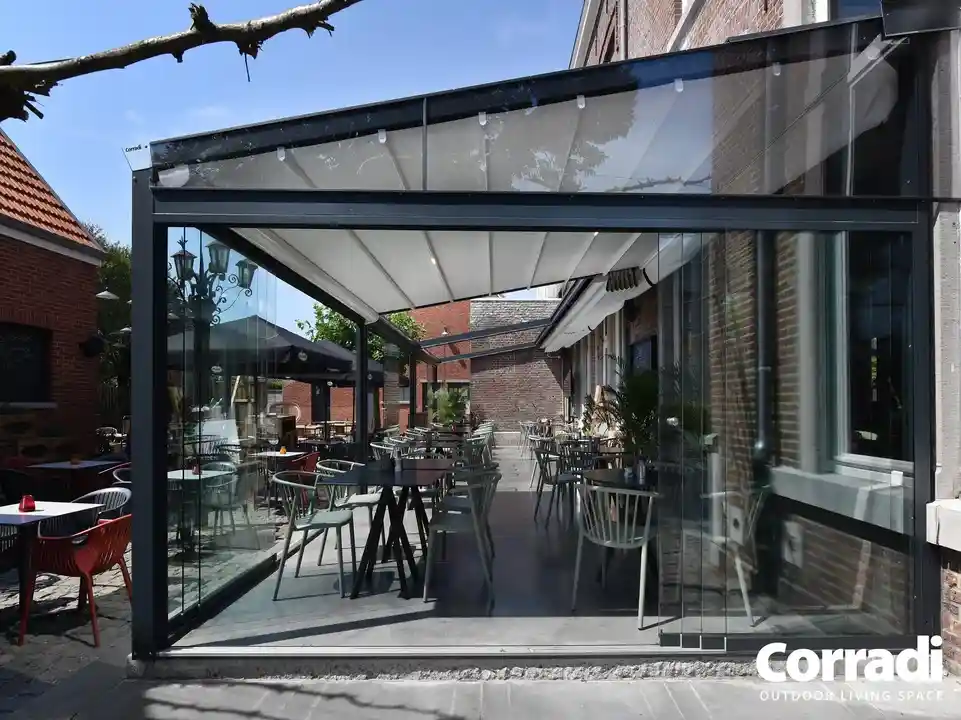
The key lies in the tensioning system. Unlike a conventional awning, which can flutter and shake in the breeze, a tensioned canvas pergola keeps the fabric completely taut thanks to a high-strength aluminium structure and a perimeter anchoring system designed to eliminate movement and vibration.
The result is a stable, silent cover with an impeccable appearance even in moderate wind.
In Ibiza, where the wind can change direction within hours, the tensioning system and the quality of the aluminium profiles are the two factors that most influence the durability and performance of the installation.
What Happens During Strong Gusts or Storms?
As with any sun-protection solution, a tensioned canvas pergola has its limits when faced with exceptional wind gusts.
The good news is that quality models incorporate automatic wind sensors that retract or protect the canvas when the system detects conditions that could compromise its safety. This means that even if you are not at home when a storm arrives, the pergola will act on its own to protect itself.
In seafront installations or on rural properties exposed to northerly winds in Ibiza, this automation is not a luxury: it is practically essential. A specialist installer familiar with the island’s conditions will guide you on the most appropriate activation threshold for each location.
How Long Does a Tensioned Canvas Pergola Last in the Ibiza Climate?
Durability is one of the key strengths of quality tensioned canvas pergolas. The factors that most influence their lifespan in the Balearic environment are:
- UV and salt resistance of the technical fabric: in Ibiza and Formentera, proximity to the sea accelerates the deterioration of low-quality materials. Premium technical fabrics are specifically treated to withstand continuous exposure to sun and marine conditions.
- Aluminium quality: the profiles must have an anodised or powder-coated finish with marine corrosion resistance to avoid problems after just a few years.
- Maintenance: with basic cleaning and periodic inspections, a well-installed tensioned canvas pergola can perform perfectly for ten years or more.
One of the practical advantages of this system is that when the canvas reaches the end of its useful life, it can be replaced without changing the structure. This significantly reduces the cost of renovation compared to rigid roofing solutions.
What Advantages Does a Tensioned Canvas Pergola Offer Over Other Systems?
An increasing number of homeowners and architects in Ibiza and Formentera are choosing the tensioned canvas pergola for very specific reasons:
- Contemporary design and visual lightness: it creates a clean, fluid canopy that integrates perfectly into modern or Mediterranean-style homes without adding visual weight.
- Ability to span large areas: canvas can be tensioned over wide spans that would be difficult or very costly to cover with a rigid structure.
- Aesthetic flexibility: the wide variety of available technical fabrics — in different colours, opacities and textures — allows the pergola to be tailored to the style of each home or business.
- Excellent value for money: compared to an aluminium bioclimatic pergola, a tensioned canvas pergola can provide large-format coverage at a lower cost, without sacrificing design.
Is a Tensioned Canvas Pergola the Best Option for Your Terrace in Ibiza?
It depends on how you plan to use it and on the conditions of your outdoor space.
A tensioned canvas pergola is an excellent solution when the main goal is sun protection with a light, modern aesthetic. If, in addition to shade, you are also looking for full protection from rain, temperature regulation, or the ability to enclose the space in winter, a bioclimatic pergola with adjustable louvres or a complementary enclosure system may be more suitable.
For this reason, before making a decision, it is essential to carry out a personalised study that takes into account the orientation of the plot, wind exposure, the type of floor or facade for anchoring, and how the space will be used. At Tanit Pergotech we analyse each project individually to recommend the solution that genuinely suits each home or business in Ibiza and Formentera.
A properly dimensioned tensioned canvas pergola, with premium materials and professional installation, is an investment that transforms any terrace into a truly enjoyable space for many years to come.
Want to find out if a tensioned canvas pergola is the right option for your terrace in Ibiza? Contact Tanit Pergotech and receive a personalised, no-obligation assessment.
Frequently Asked Questions About Tensioned Canvas Pergolas
Does a tensioned canvas pergola withstand the wind?
Yes. Thanks to its perimeter tensioning system and aluminium structure, the canvas remains stable in moderate wind. For very strong gusts or storms, quality models incorporate automatic wind sensors that retract or protect the canvas before the wind can damage it.
How long does the canvas of a tensioned pergola last in Ibiza?
With quality materials and basic maintenance, the canvas can last between 8 and 12 years. Premium technical fabrics are resistant to UV rays, sea salt and rainfall. When the canvas deteriorates, it can be replaced without needing to change the aluminium structure.
Does a tensioned canvas pergola require much maintenance?
No. Regular cleaning of the fabric and aluminium structure, along with an annual inspection of the anchors and tensioning system, is all that is needed. It is especially important to remove salt residue from installations near the sea in Ibiza or Formentera.
Is a tensioned canvas pergola better than a bioclimatic pergola?
It depends on the project. A tensioned canvas pergola is ideal for shade with a light, modern aesthetic and can cover large surfaces. A bioclimatic pergola offers greater versatility: it regulates temperature, protects from rain and can enclose the space. A specialist can advise you based on your specific needs.
Can I install a tensioned canvas pergola near the sea in Ibiza?
Yes, but it is essential to choose fabrics with anti-UV and anti-salt treatment, and aluminium structures with a high-resistance marine anti-corrosion finish. Installation must be carried out by a professional with experience in the Balearic coastal environment.